


Every year, around now I get a couple of calls or DMs that always say the same thing - the board is worried by the October numbers and they’re asking “Why are we still spending on this?“
I’ve sat on the other side of that table. When I was brand side, Q4 meant two things: hitting some very lofty targets, and making sure our marketing didn’t topple the warehouse. We’d huddle round a screen as our big campaigns went live, hoping the orders would keep ticking up while not going too far as to topple our warehouse.
We couldn’t always. More than one year, I ended up in Northampton in a high-vis vest, packing boxes until the backlog cleared. A nice problem to have, I’ll grant you. But it only happened because we’d spent the whole autumn making sure people knew who we were before the big day arrived.
So if you’re being asked to cut spend right now, and you’re wondering whether you’re mad to push back: you’re not. But you’ll need more than a gut feeling to win that argument.
Why October looks so bad
If your numbers look wonky right now, it isn’t just you. Across our clients from late September to mid-October, traffic was up 9% on last year but conversion rate was down 10%.
Order values were up 11%, mostly because prices have gone up, so revenue was roughly flat (+1.2%). On a dashboard, that looks like money pouring into a leaky bucket.
It isn’t. Shoppers (myself included) haven’t lost interest; we’re browsing, comparing, building lists and waiting for deals we know are coming. The British Retail Consortium put it neatly this month: plenty of people are asking themselves whether what they’re about to buy will be cheaper next week.
What’s actually going on
The sales get earlier and earlier every year. Led by the electrical and home industries! Our sister company Genie Shopping works with more than 1,000 retailers. Last Black Friday, two thirds of the purchases they tracked came from clicks made on the day. The other third came from people who’d clicked earlier in the week, or the month. Cyber Monday told the same story. (Thanks to Rob Longmate for the insight).
People are already waiting. In Google’s survey this summer, 84% of last year’s Black Friday shoppers in Europe said they were holding off on a purchase until this year’s. Nearly half of those were in the €100–€500 range: the considered stuff people research for weeks, not impulse buys.
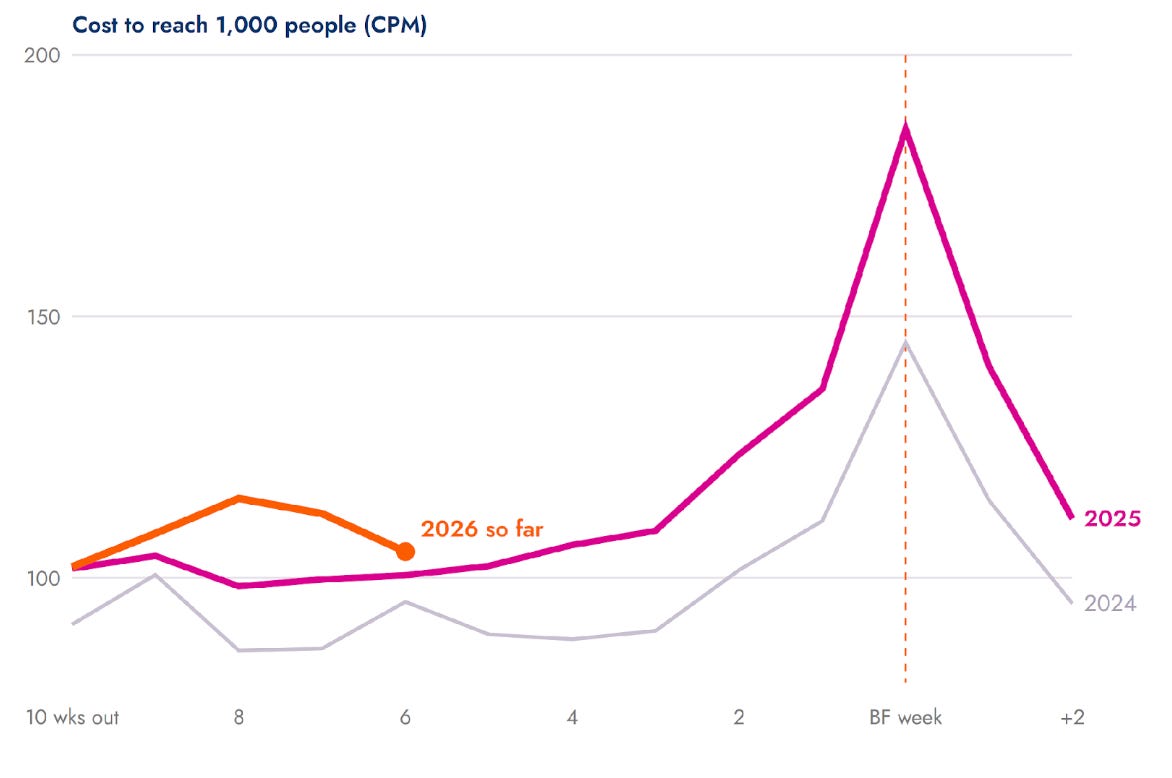
Attention is cheap now, and it won’t be in three weeks. On Meta last year, reaching people in the week of 27 October cost just 6% more than a normal autumn week, and each sale cost 19% less. By Black Friday week, reaching the same people cost 86% more. (Shoutout to Sam Thompsett for the data).
Jérémy Courty showed me search tells a similar story. Across our clients last year, every £1 spent on Google brought back £9.80 in late October. In Black Friday and Cyber week, that dropped to £6.80. The cheap bit of the season is the bit that looks worst on a weekly report.
My favourite example was one client went on sale on 1 October. In week one, they got £3.35 back for every £1, against a target of £4. Plenty of boards would have pulled the plug right there. A week later, it was £4.75.
TL;DR - What to tell the board
“About a third of Black Friday sales come from people who clicked on us earlier in the month. If we cut now, we’re cutting part of Black Friday too.”
“The ads we’re buying now are the cheapest we’ll get all quarter. Last year, the cost of reaching people nearly doubled by Black Friday week.”
“October always looks weak right before the peak. Let’s judge this on the whole of November, not on three weeks of October.”
Then ask for one thing: agree now what “working” looks like across the whole period, so nobody pulls the plug on a wobbly Tuesday.
The strongest version of this argument is your own data. Pull last year’s weekly spend and sales from October to Cyber Monday and put them on one chart. It’s much harder to argue with your own history than with an agency’s benchmark (even a very good one)
5 things I’d do this week
Every brand is different, so take what fits. But if I were still brand side with Black Friday three weeks away, this is what I’d be thinking:
Collect sign-ups while they’re cheap. This is being seen across the board this year. The likes of Dermalogica, Gym King and The Works are already running early-access ads. Most aren’t leading with a discount; they’re just getting people on their list before costs jump.
Tell people it’s your lowest price. Which? found 83% of products were the same price or cheaper outside the sales. Shoppers know this, which is why they wait. If your Black Friday price really is the lowest it’ll go, say so loudly. It’s never too late to add, and it gives people a reason to buy now.
Check Google isn’t running offers you didn’t approve. Google switched on automated promotions in October, which can pull deals off your site, VIP or affiliate codes included. We turned it off across our accounts and it still crept through on one. Check twice.
Keep the same ads running from Black Friday to Cyber Monday. Swapping in a fresh set for Cyber Monday sends Meta back to square one on the most expensive days of the year. Change the offer through your product feed and promo codes instead.
Loosen your targets a little. A click you buy today can turn into a sale weeks later, and Google gives you credit for up to 30 days after it. Strict return targets in October choke off the very traffic you need in November.
So, are you mad?
No. The brands that end up in high-vis in late November packing more orders than they expected are usually the ones that kept spending when October looked rubbish.
Next month, I’ll be back with what actually happened this peak, the good bits and the bits we got wrong.
In the meantime: what’s the question you’d only ask a friend? Drop it in the comments or send me a message. It might just be the next issue.